aM
atelierMIDE

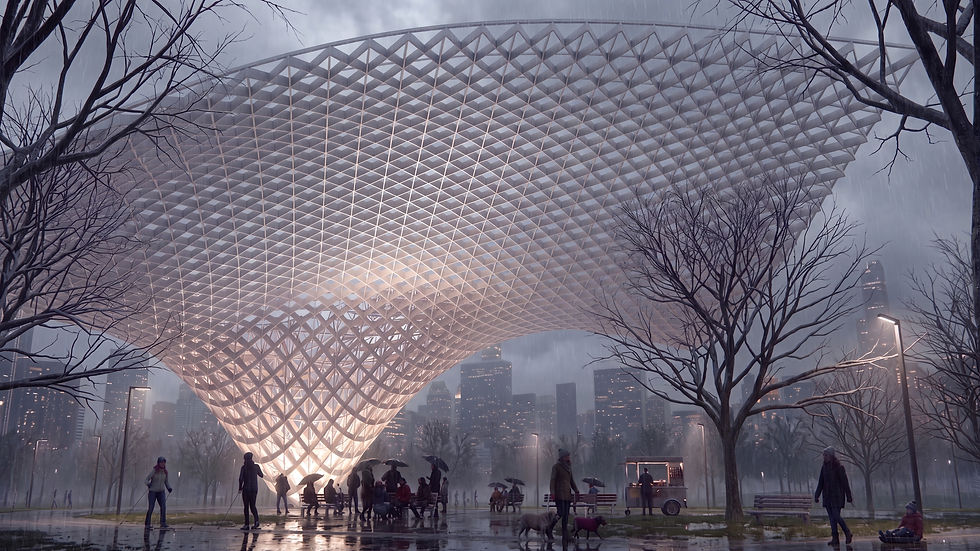
Central Park doesn’t need a building that competes with it — it needs one that thinks the way it grows. atelierMIDE’s pavilion concept borrows its structure from nature: a diagrid skin that tapers like a wing, thin where wind peaks, deep where it needs to shelter. Generated parametrically from wind, snow, and sun — not sculpted after the fact — it sheds snow in winter, filters shade in summer, and glows as a lantern after dark. In nature, the form that survives is the form that belongs.
Congregation

Celebration
Central Park doesn’t need a building that competes with it — it needs one that thinks the way it grows. atelierMIDE’s pavilion concept borrows its structure from nature: a diagrid skin that tapers like a wing, thin where wind peaks, deep where it needs to shelter. Generated parametrically from wind, snow, and sun — not sculpted after the fact — it sheds snow in winter, filters shade in summer, and glows as a lantern after dark. In nature, the form that survives is the form that belongs.
CENTRAL PARK, NEW YORK CITY
billow - pavilion
PROJECT DESIGN DIRECTOR | PROJECT DESIGNER
2026 | atelierMIDE
Central Park doesn’t need a building that competes with it — it needs one that thinks the way it grows. atelierMIDE’s pavilion concept borrows its structure from nature: a diagrid skin that tapers like a wing, thin where wind peaks, deep where it needs to shelter. Generated parametrically from wind, snow, and sun — not sculpted after the fact — it sheds snow in winter, filters shade in summer, and glows as a lantern after dark. In nature, the form that survives is the form that belongs.
Architecture Design: atelierMIDE